Showing posts with label Haiti. Show all posts

Tuesday, December 20, 2011

Guaikano


DID YOU KNOW: The term guaikano (guaicano) is a Taino word for the remorafish (scientific name Echeneidae). Sometimes called a suckerfish, the guaikano (remora) is best known for its distinctive dorsal fin, which takes the form of an oval, sucker-like organ allowing them to take a firm hold against the skin of larger marine animals and even boats. Usually found in tropical or temperate waters, guaikano are known to grow between 1-3 ft long (30–90 cm). Among the Taino, the guaikano was once used by fisherman, specifically, because of its abilities to attach on to larger animals such as turtles and sharks. A cord or “kabuia (cabuya)” would be tied to the guaikano’s tail, and once the fish attached, a Taino fisherman could simply haul in both the guaikano and its host. - UCTP Taino News © 2011

Illustration: Modesto Garcia 

Thursday, May 27, 2010

Haiti is a Taino Word


Did You Know: Haiti is one of the ancient Taino names for the island the Spaniards named Hispaniola, which is today spilt between what is now the Dominican Republic and Haiti. Other words include Ayiti, Kiskeia, and Bohio. Haiti is said to mean "Highlands." - UCTP Taino News © 2010

Tuesday, April 21, 2009

The West Indian Boa: MAHA

Did You Know: West Indian boas (Epicrates) snakes that are found throughout the Caribbean islands. In the Major Antilles, some species are still known by their Taino name MAHA (Maja). These snakes range in size and coloration. Maha are primarily ground-dwellers, although they may also climb trees. On several Caribbean islands Maha gather at cave entrances at night, snatching bats out of the air as they exit or enter the cave. As in other boas, the Maha young feed on small animals such as lizards, whereas the large adults tend to feed on larger mammals and birds. Generally speaking, each island has a single, unique species. The exception is the island of Kiskeia (Haiti and the Dominican Republic), which has three species. The Cuba Boa is one of the largest of the boa group or genus and it is the primary predator of the hutia (Capromys Pilorides), an indigenous island rodent. Like many Maha, they are endangered today not only by natural phenomenum like hurricanes but also from deforestation. Maha also also endanger from local island residents who kill these snakes thinking they are a threat to poultry. The Maha can be seen depicted in ancient Taino art forms from stone work to wood and clay. For the ancient Taino, the Maha was not seen as an ill omen but part of the nature world with its own unique lessons to share. - - UCTP Taino News © 2009

Wednesday, February 28, 2007

Quiskeya is a Taino Name


Did You Know: Quisqueya or Kiskeia (Kiskeya) is one of the Taino names for the island of Hispaniola, or what is now the Dominican Republic and Haiti. The name, is said to mean "Mother of the Earth," and is still used to this day. Many Dominicans still refer to their island as La Isla Quisqueya, and refer to themselves as Quisqueyano. – UCTP Taino News (c) 2007

Click on Map for Larger View

Tuesday, January 9, 2007

Taino were Warriors

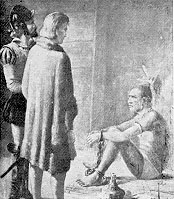
Did You Know: Although well-renowned for their observance of a culture of peace, the Taino did not willingly succumb to Spanish colonization. In fact, not long after Columbus’s arrival, Taino in Haiti successfully revolted against the first Spanish attempts to conquer their ancient island homeland. This Taino offensive against the Spanish invaders was carried out as early as in 1492 with the destruction of the Fort Navidad following Columbus’ return to Spain. Upon his return to the fort, Columbus learned that the Taino had killed all his men in a swift military operation led by Kaonabo, a cheiftain or Kasike of Maguana, an indigenous territory near the center of the island. The rape of Taino women was among the main reasons the Taino turned to hostility. Kaonabo led a resistance against the Spaniards until he was finally captured and imprisoned. Kaonabo is said to have perished at sea while on route to face the Spanish Crown in 1496. - UCTP Taino News (c) 2007